
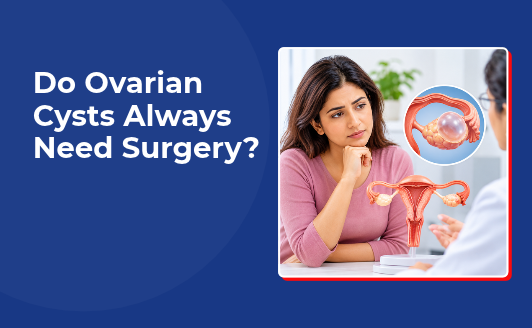
Surgery is not always necessary for an ovarian cyst. Most cysts are small, fluid-filled and cause no symptoms. Many disappear on their own within a few menstrual cycles.That is why ovarian cyst treatment without surgery, usually through regular monitoring,is where most women start. An operation enters the picture only when a cyst grows large, causes pain or looks unusual on a scan.
According to Dr. Ankesh R. Sahetya, Obstetrician and Gynaecologist at Pushpaa Hospital, a Maternity Hospital in Andheri West, “Finding a cyst on a scan is not the same as needing surgery. How it looks on ultrasound, its size, any symptoms, the patient’s age and plans for pregnancy all count. Plenty of cysts only need a repeat scan a few weeks later, and surgery is saved for the ones that persist, grow or cause trouble.”
For guidance on ovarian cyst treatment options.
Can an Ovarian Cyst Be Treated Without Surgery?
Quite often, yes. A lot of cysts turn up by accident during a scan done for some other reason.
- Most cysts are functional. They come from the normal monthly cycle, when a follicle or the corpus luteum fills with fluid. They tend to shrink without any help.
- Small and simple ones get watched. If a cyst looks plain on ultrasound and there are no symptoms, a repeat scan is usually all that is planned.
- The second scan answers a lot. It is booked a few weeks or a few months later. A cyst that has gone needs nothing more.
- Hormonal pills are not a shortcut. Studies show they do not clear an existing functional cyst any faster than waiting does. Whether any medicine is needed at all is the doctor’s call.
- Surgery is still there if needed. When a cyst refuses to settle, keyhole options such as laparoscopic ovarian cyst removal can be talked through.
When Does an Ovarian Cyst Need Surgery?
Some cysts do need to come out. The doctor judges that from the scan and from how the patient feels.
- It stays or keeps growing. A cyst still sitting there on follow-up scans may be removed.
- The pain does not go away. Ongoing pain or pressure low in the abdomen can be reason enough. That includes cysts linked to endometriosis, which are handled differently from ordinary functional ones.
- The pain is sudden and sharp. Severe lower abdominal pain, sometimes with nausea or vomiting, needs a doctor’s assessment. It can mean a cyst has burst or an ovary has twisted.
- The scan shows something unusual. Solid areas or thick internal walls usually lead to removal and lab testing, to rule out rarer and more serious causes.
- The cyst is large. Large or persistent cysts generally need to be removed. Keyhole surgery works for most, though some need a single larger cut.
What Determines the Treatment for an Ovarian Cyst?
No two cysts are managed in quite the same way. Ovarian cyst treatment follows a few practical questions.
- How big and how complex it looks. A thin-walled, simple cyst is handled differently from a complex or solid-looking one.
- Whether it causes symptoms. A cyst found by chance gets a different plan from one that is causing pain or upsetting the periods.
- Age and menopause. After menopause the chance of a serious cause is slightly higher, so scans and blood tests are advised more closely.
- Plans for pregnancy. Before menopause, surgeons try to protect as much of the reproductive system as they can. A related post covers how common female infertility is.
- What kind of cyst it is. Functional cysts mostly settle alone. Endometriomas and dermoid cysts are followed with regular scans and removed if they grow or cause symptoms.
Key Takeaways
- Most ovarian cysts are harmless and many go away without treatment.
- A repeat scan is the usual first step for a small cyst with no symptoms.
- Surgery is for cysts that are large, persistent, painful or unusual on a scan.
- Age, symptoms, cyst type and plans for pregnancy all feed into the decision.
Frequently Asked Questions
Can an ovarian cyst disappear on its own?
Often it can. Many settle within a few months.
How is a cyst watched without surgery?
With repeat ultrasound scans, usually a few weeks or months apart.
Do all ovarian cysts cause symptoms?
No. Plenty cause nothing and are only found during a scan.
Does removing a cyst always mean open surgery?
No. Keyhole surgery works for most cysts.
References
- National Health Service (NHS), UK: Ovarian cyst: Treatment
- National Library of Medicine (NIH): Ovarian Cyst, StatPearls
Disclaimer:This blog is for general informational purposes and does not replace professional medical advice.
