
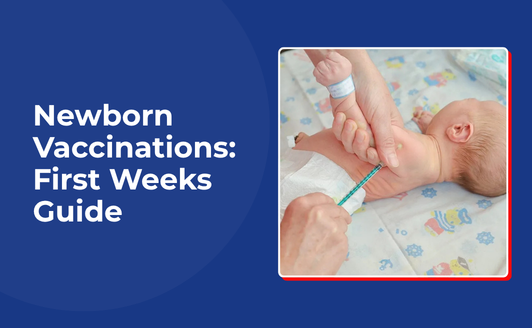
A newborn needs three vaccines in the first few weeks of life: BCG, the birth dose of Hepatitis B, and Oral Polio Vaccine (OPV-0). All three are administered within 24 to 72 hours of birth, usually before the baby leaves the hospital. Together, they offer early protection against tuberculosis, chronic liver infection, and poliovirus. The next round of vaccines isn't due until six weeks, so this initial schedule matters more than it might seem.
According to Pushpaa Hospital in Andheri West, newborn vaccinations are one of the most overlooked parts of early newborn care, and timely administration in the first 72 hours plays a critical role in long-term immunity.
Worried your baby missed the birth dose window?
Why Are Birth-Dose Vaccines Given So Early?
The first three days of life are when a newborn's exposure risk is highest and the immune system is still well positioned to respond. Here is what determines this timing.
Liver protection: Hepatitis B can be transmitted from mother to child during delivery, so the vaccine is most effective when administered before the virus has an opportunity to establish itself, and any delay reduces this protective window.
TB shield: BCG offers the greatest benefit when given immediately after birth, before the child is exposed to environments where TB bacteria are commonly present. While it does not prevent every case, it significantly reduces the risk of severe disease.
Polio start: OPV-0 does not replace the later polio doses. It provides early exposure to the gut lining, allowing the remaining doses in the series to build on this initial protection.
Minimal discomfort: Newborns generally tolerate these early doses well. Discomfort is minimal and short-lived, unlike the mild fever that may accompany some later vaccinations.
Completing all three doses before discharge is important, as follow-up compliance tends to decline once a family leaves the hospital. This is particularly relevant for babies born from a closely monitored high-risk pregnancy, where adherence to the vaccination schedule requires more careful tracking.
Struggling to conceive?
Our fertility specialists offer personalized IVF treatment plans with high success rates.
When Should Parents Schedule the Next Round of Vaccines?
The next round of vaccines is not due until the baby is six weeks old, so no further hospital visits are required before that. A few points are worth knowing about this period.
Six week mark: The pentavalent vaccine, covering diphtheria, pertussis, tetanus, Hepatitis B, and Hib, is administered at this visit along with IPV, rotavirus, and pneumococcal vaccine.
Growth check: This appointment typically includes a growth and development assessment, making it a suitable time to discuss feeding or sleep-related concerns with the pediatrician.
Fever prep: A mild fever following the six-week vaccines is common and generally resolves within a day. Paracetamol drops may be used if advised by the pediatrician.
Records matter: Parents are advised to retain the vaccination card provided by the hospital, as each subsequent dose is recorded against the birth-dose entries.
A short delay of a few days beyond the six-week mark is usually not a cause for concern, though maintaining the recommended schedule remains advisable. Planning ahead in this manner is a consideration that often arises during preconception counselling as well, including discussions around female infertility, where early planning similarly supports a smoother pregnancy and newborn phase.
Why Choose Pushpaa Hospital for Newborn Care?
Pushpaa Hospital has cared for women and families since 1986, guiding each pregnancy from preconception through delivery and into postnatal and newborn care, all under one roof and under continuous medical supervision.
Parents who follow a well-timed vaccination schedule, supported by proper clinical guidance, tend to see fewer complications and hospital readmissions in the first month of the baby's life. Timely, well-supervised care in these early weeks plays a meaningful role in a newborn's long-term protection and wellbeing.
Phone: Call +91 77158 10228 to book your consultation
Frequently Asked Questions
Is the BCG vaccine given even if the baby is premature?
Yes, though timing may be adjusted based on birth weight and pediatrician assessment.
2. At what age does female fertility begin to decline?
Fertility gradually declines in the late twenties and early thirties, with a more noticeable decrease after 35 years of age.
Can a newborn get all three birth vaccines on the same day?
Yes, BCG, Hepatitis B, and OPV-0 are routinely given together at birth.
Does breastfeeding affect vaccine effectiveness?
No, breastfeeding doesn't interfere with vaccine response in newborns.
What if the birth dose is missed at the hospital?
It should be given as soon as possible, ideally within the first week.
References
- World Health Organization – Hepatitis B Vaccines: WHO Position Paper
- World Health Organization – Recommended Routine Immunizations for Children
Disclaimer: This blog is for general informational purposes and does not replace professional medical advice.
